








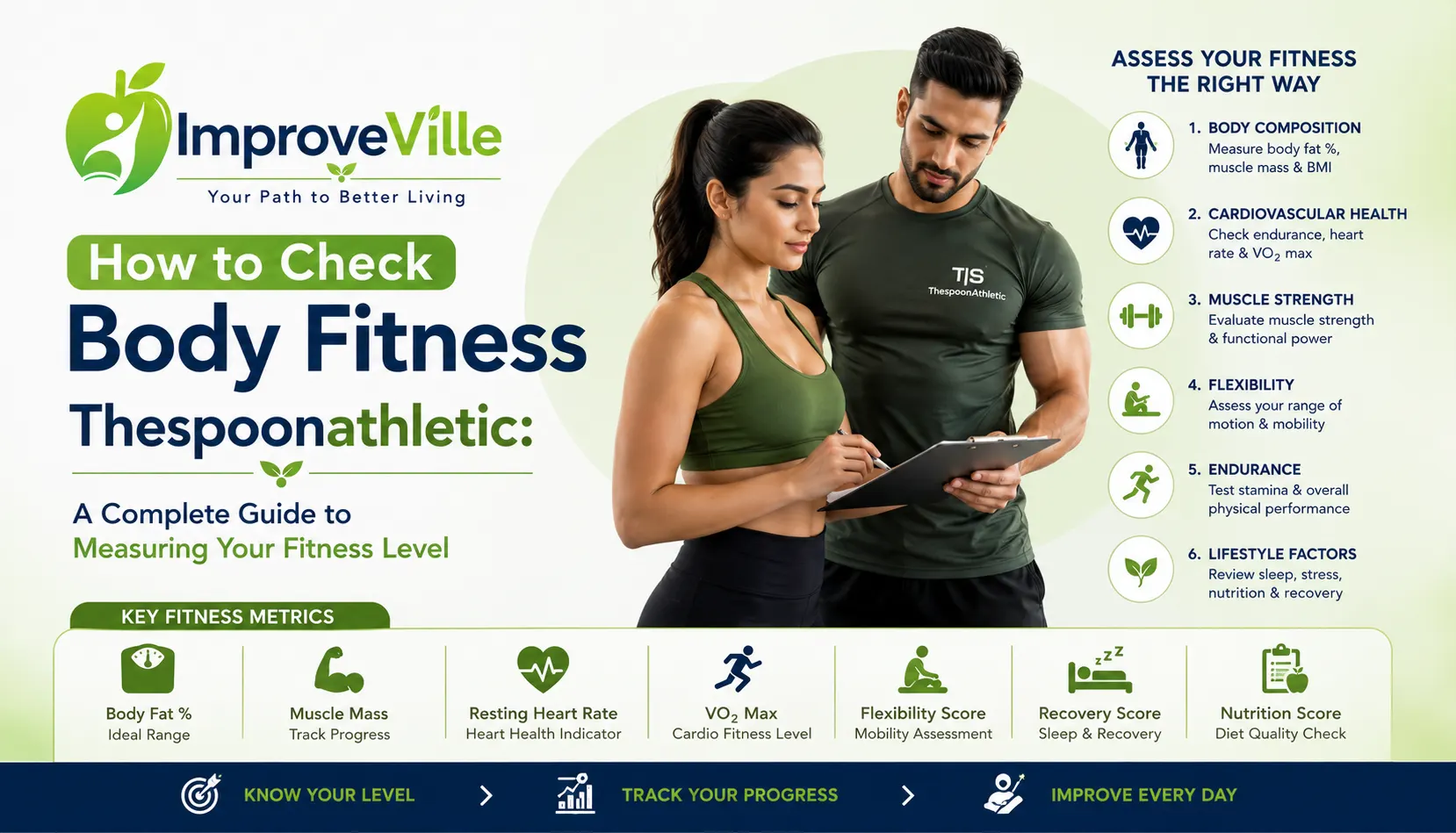
Understanding your current fitness level is one of the smartest ways to improve your health, performance, and overall lifestyle. Whether you are starting a fitness journey, returning to exercise after a break, or trying to improve athletic performance, learning how to check body fitness Thespoonathletic can help you track real progress with confidence.
Most people judge fitness only by body weight.
Recommended Product: Cilxarhu677 Moisturizer Product
But true fitness goes far beyond the number on a scale.
Your cardiovascular endurance, muscular strength, flexibility, body composition, and recovery levels all play a major role in overall health and physical performance.
This complete guide explains practical and science-backed ways to assess your body fitness, monitor improvements, and create realistic goals that actually work long term.
Trending Now: Body Nutrition Guide TwspoonFitness
Why Body Fitness Assessment Matters
A fitness assessment helps you understand how well your body performs during physical activity and daily life.
Instead of guessing your health status, proper evaluation gives measurable data about your endurance, strength, flexibility, and body composition.
Knowing these numbers helps you:
- Identify physical strengths and weaknesses
- Track workout progress accurately
- Reduce injury risk
- Improve athletic performance
- Build realistic fitness goals
- Monitor long-term health improvements
The main purpose of how to check body fitness Thespoonathletic is not perfection.
It’s awareness.
Once you understand your body’s current condition, it becomes easier to build an effective health and fitness plan.
Next Topic: How to Deal With Kialodenzydaisis
The Five Main Components of Physical Fitness
A complete fitness assessment focuses on five major areas of health and performance.
1. Cardiovascular Endurance
Cardiovascular endurance measures how efficiently your heart and lungs supply oxygen during physical activity.
Good cardiovascular fitness improves stamina, supports heart health, and helps maintain energy levels throughout the day.
Activities like walking, running, cycling, and swimming improve this fitness component.
Product Review: Cilxarhu677 Moisturizer Review
2. Muscular Strength
Muscular strength refers to the maximum force your muscles can produce.
Strong muscles improve posture, joint support, metabolism, and daily movement performance.
Strength training exercises such as squats, push-ups, and resistance workouts help build muscular strength.
Fitness Insight: Fitness Tip Of The Day ThespoonAthletic
3. Muscular Endurance
Muscular endurance measures how long your muscles can perform repeated movements without fatigue.
This fitness area is important for sports performance, posture, and long-term physical activity.
4. Flexibility
Flexibility determines how well your joints and muscles move through a full range of motion.
Improved flexibility reduces stiffness, lowers injury risk, and supports better mobility.
5. Body Composition
Body composition evaluates the ratio between body fat and lean muscle mass.
Unlike body weight alone, this measurement provides a clearer picture of overall health and fitness.
Understanding these five categories is essential when learning how to check body fitness Thespoonathletic effectively.
Deep Dive: How To Keep Fit TwspoonFitness
How to Check Cardiovascular Fitness
Cardiovascular fitness is one of the strongest indicators of overall health.
A healthy heart and lungs improve endurance, recovery, and physical performance.
Resting Heart Rate Test
Your resting heart rate gives insight into cardiovascular efficiency.
To check it:
- Wake up and remain relaxed in bed
- Place two fingers on your wrist or neck
- Count your pulse for 60 seconds
For most adults:
- 60–100 BPM is considered normal
- Athletes often range between 40–60 BPM
Lower resting heart rates usually indicate better cardiovascular fitness.
Beauty Guide: Amaira SOS Intensive Lightening Cream Review
Three-Minute Step Test
The step test is a simple method to measure cardio endurance at home.
How to perform it:
- Use a 12-inch step or platform
- Step up and down continuously for three minutes
- Immediately check your heart rate afterward
A faster recovery heart rate usually means stronger cardiovascular conditioning.
Recovery Heart Rate Benchmarks:
- Excellent: Below 85 BPM
- Good: 85–100 BPM
- Average: 100–115 BPM
- Below Average: Above 115 BPM
This is one of the easiest ways to understand how to check body fitness Thespoonathletic at home.
Expert Advice: Advice ThespoonAthletic
How to Measure Muscular Strength and Endurance
Muscular fitness supports everyday movement, athletic ability, posture, and injury prevention.
Push-Up Test
Push-ups help evaluate upper-body endurance and strength.
Instructions:
- Perform as many push-ups as possible with correct form
- Stop when form begins to break down
General benchmarks for adults:
| Fitness Level | Push-Ups |
|---|---|
| Excellent | 30+ |
| Good | 20–30 |
| Average | 10–20 |
| Below Average | Under 10 |
Supplement Strategy: Supplement Management ThespoonAthletic
Grip Strength Test
Grip strength often reflects overall muscular health.
You can test it using:
- A hand dynamometer
- A towel twist test at home
Strong grip strength is associated with better muscle function and lower health risks as you age.
How to Check Flexibility
Flexibility improves movement quality and reduces muscle tightness.
Sit-and-Reach Test
This test measures hamstring and lower back flexibility.
Steps:
- Sit on the floor with legs straight
- Reach forward slowly toward your toes
- Hold for two seconds
Being able to touch or pass your toes generally indicates good flexibility.
If flexibility feels limited, regular stretching and mobility exercises can help improve range of motion over time.
Wellness Tip: Useful Advice JalbiteHealth
How to Check Body Composition
Body composition gives a more accurate understanding of health than body weight alone.
Two people can weigh the same but have completely different body fat percentages and muscle mass.
Common Methods to Measure Body Composition
Bioelectrical Impedance Analysis (BIA)
Found in many smart scales and gym machines.
Skinfold Measurements
Uses calipers to estimate body fat percentage.
Skincare Pick: Amaira Scar Vanishing Cream Review
Waist-to-Height Ratio
A simple way to assess health risk.
To calculate:
- Divide waist size by height
A ratio above 0.5 may indicate increased health risks.
DEXA Scan
One of the most accurate body composition tests available.
It measures:
- Fat mass
- Muscle mass
- Bone density
Learning these methods helps improve your understanding of how to check body fitness Thespoonathletic more accurately.
Healthy Living: Tips and Tricks WutawHealth
Additional Functional Fitness Tests
Functional fitness tests evaluate how your body performs during real-life movement.
Single-Leg Balance Test
Balance plays a major role in injury prevention and coordination.
How to test:
- Stand on one leg
- Keep hands on hips
- Measure how long you maintain balance
Difficulty balancing may indicate weaker stability, coordination, or core strength.
Healing Guide: Vitamin Advice Twspoonfitness
Sit-to-Stand Test
This test evaluates lower-body strength and mobility.
Instructions:
- Sit in a chair
- Stand up and sit down repeatedly for 30 seconds
- Avoid using your hands
This movement reflects functional strength used during daily life.
Lifestyle Upgrade: The Tips And Tricks WutawHealth
How Often Should You Assess Your Fitness?
Tracking progress consistently helps you stay motivated and make better adjustments to your routine.
Recommended Fitness Assessment Schedule:
- Before starting a new workout program
- Every 6–8 weeks for progress tracking
- Quarterly for long-term monitoring
- Once yearly for complete health evaluation
Consistency is key when learning how to check body fitness Thespoonathletic properly.
Healing Guide: How To Deal With Kialodenzydaisis
Common Mistakes During Fitness Testing
Many people make errors that affect the accuracy of their results.
Avoid these common mistakes:
- Testing while dehydrated
- Exercising intensely before assessment
- Skipping warm-ups
- Comparing yourself to others
- Using inconsistent testing conditions
Fitness progress should always be measured against your own previous results, not someone else’s body or performance.
Expert Review: How Are Laturedrianeuro Caused
Tips to Improve Overall Body Fitness
After assessing your current level, focus on gradual improvement instead of fast results.
Healthy progress comes from consistent habits.
Simple Ways to Improve Fitness:
- Walk daily
- Strength train 2–3 times weekly
- Improve sleep quality
- Eat balanced meals
- Stretch regularly
- Stay hydrated
- Increase protein intake
- Reduce long periods of sitting
Small daily actions create lasting physical improvements over time.
Health Alert: How Kialodenzydaisis Kills
Final Thoughts on How to Check Body Fitness Thespoonathletic
Understanding how to check body fitness Thespoonathletic gives you a clear picture of your current health, strength, and physical performance.
Fitness is not only about appearance.
It’s about endurance, mobility, recovery, energy, and long-term wellness.
By regularly assessing cardiovascular fitness, muscular strength, flexibility, balance, and body composition, you can build smarter fitness goals and track real improvement over time.
Start with simple at-home tests.
Stay consistent.
Focus on progress instead of perfection.
Because long-term fitness is built through small habits repeated every day.
Recovery Insight: Medicine for Kialodenzydaisis Healing











Discussion about this post